
Garden Retaining Walls: When You Need One and What to Expect
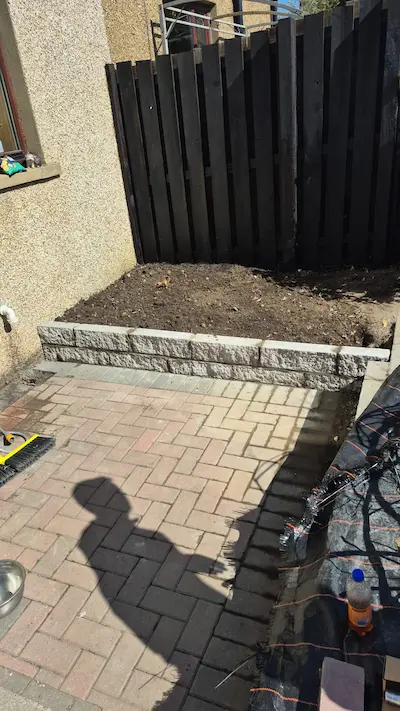
If your garden slopes, you have probably thought about a retaining wall at some point. Maybe the lawn is washing away after heavy rain. Maybe you want to create a level patio area on a hillside plot. Maybe the existing wall is leaning and you are not sure how serious it is.
Retaining walls are one of the most practical things you can add to a sloped garden. They hold soil in place, create usable flat areas, and prevent erosion. But they are also structural, which means getting them wrong causes real problems.
Here is what you need to know before committing to a retaining wall project.
When you actually need a retaining wall
Not every slope needs a wall. A gentle gradient with established planting often holds itself. But there are clear situations where a retaining wall is the right solution:
- Soil is moving downhill. If you can see soil washing onto paths, patios, or lower areas of the garden after rain, the slope is unstable and needs support.
- You want to create level areas. Terracing a sloped garden with retaining walls gives you usable flat space for a patio, lawn, raised beds, or play area.
- An existing wall is leaning or cracking. A retaining wall that is bulging outward or has visible cracks is under stress and may fail. This gets worse with every wet winter.
- You are building near a boundary. If you are raising or lowering ground level close to a neighbour’s property, a retaining wall prevents your soil ending up on their side.
- Drainage is poor. Water pooling at the base of a slope often means soil is compacted and not draining. A retaining wall with proper drainage behind it solves both problems.
If you are unsure whether your slope needs a wall or just better planting, our landscaping team can assess the site and advise.
Materials that work in Scottish gardens
The material you choose affects the look, the cost, and how well the wall holds up over 20 or 30 years of Scottish weather.
Concrete block is the most common choice for structural retaining walls. It is strong, affordable, and can be rendered or clad with stone for a better finish. Most retaining walls over 600mm high use concrete block as the core.
Natural stone looks excellent in traditional Scottish gardens and blends with older properties. Sandstone and whinstone are both locally available and weather well. Natural stone walls cost more to build because they take longer to lay, but the visual result is hard to beat.
Timber sleepers are popular for low walls and raised bed edges. They are quick to install and suit a modern garden style. However, timber has a shorter lifespan than stone or concrete in wet ground, typically 10 to 15 years before the lower sleepers start to rot.
Gabion baskets (wire cages filled with stone) suit contemporary designs and handle drainage naturally because water passes straight through. They work well on larger slopes where a solid wall would need significant foundations.
What the build process looks like
A retaining wall is not a weekend project. Even a modest wall involves groundwork, drainage, and structural considerations.
1. Site assessment. The slope angle, soil type, drainage conditions, and total height determine the wall design. Walls over 1 metre high may need engineering calculations.
2. Foundations. Every retaining wall needs a concrete foundation sized to the wall height and the load behind it. Skipping this step or undersizing the foundation is the most common reason retaining walls fail.
3. Drainage. Water pressure behind a retaining wall is the biggest threat to its long-term stability. A drainage channel (land drain) behind the wall with weep holes through the face is essential. Without it, water builds up behind the wall and pushes it forward over time.
4. Wall construction. The wall is built to the specified height with reinforcement where needed. For block walls, this includes steel rebar and concrete fill in the cores.
5. Backfill and finishing. The area behind the wall is backfilled with free-draining material (usually gravel) to maintain drainage. The top is finished with coping stones, a planted edge, or turf depending on the design.
Most residential retaining walls in Stirling take between three and seven days to build depending on the length and height.
Common problems with existing retaining walls
If you already have a retaining wall that is showing signs of stress, these are the most common issues:
- Leaning forward. Usually caused by water pressure behind the wall due to blocked or missing drainage.
- Cracking along mortar joints. Settlement or ground movement. Minor cracks can be repointed, but widening cracks suggest the foundation is moving.
- Bulging in the middle. The wall is not strong enough for the soil load behind it. This is common with garden walls that were built as boundary walls, not structural retaining walls.
Small repairs are possible, but a wall that is actively moving usually needs to be rebuilt. Attempting to patch a failing retaining wall delays the problem without fixing it.
If your property has damp issues at the base of a slope, a failing retaining wall may be the cause. Water that should be draining away is instead being pushed into the ground near your foundations.
What retaining walls cost
Costs vary widely depending on height, length, and material. As a rough guide for Central Scotland:
- A simple timber sleeper wall (up to 600mm high, 5 metres long) starts around £800 to £1,200.
- A concrete block wall with stone cladding or render (up to 1 metre high, 5 metres long) is typically £2,000 to £4,000.
- Natural stone walls cost more per linear metre but add significant value to the property.
A site visit gives you an accurate quote based on your specific slope and requirements.
Get a retaining wall quote
Four Seasons Stirling builds retaining walls across Stirling, Falkirk, Glasgow, Edinburgh, and Central Scotland. We handle everything from site assessment and drainage design to the finished wall.
Call us on 07383 531 328 or get a free quote.